Everything else makes you generate faster. This is the gate before it ships.
The Ship Gate is seven Claude Code skills for the part that happens after something is built and before it goes out: an eight-dimension review that cannot contradict itself, plus the maintenance loops that stop a growing skill library and memory store quietly rotting.
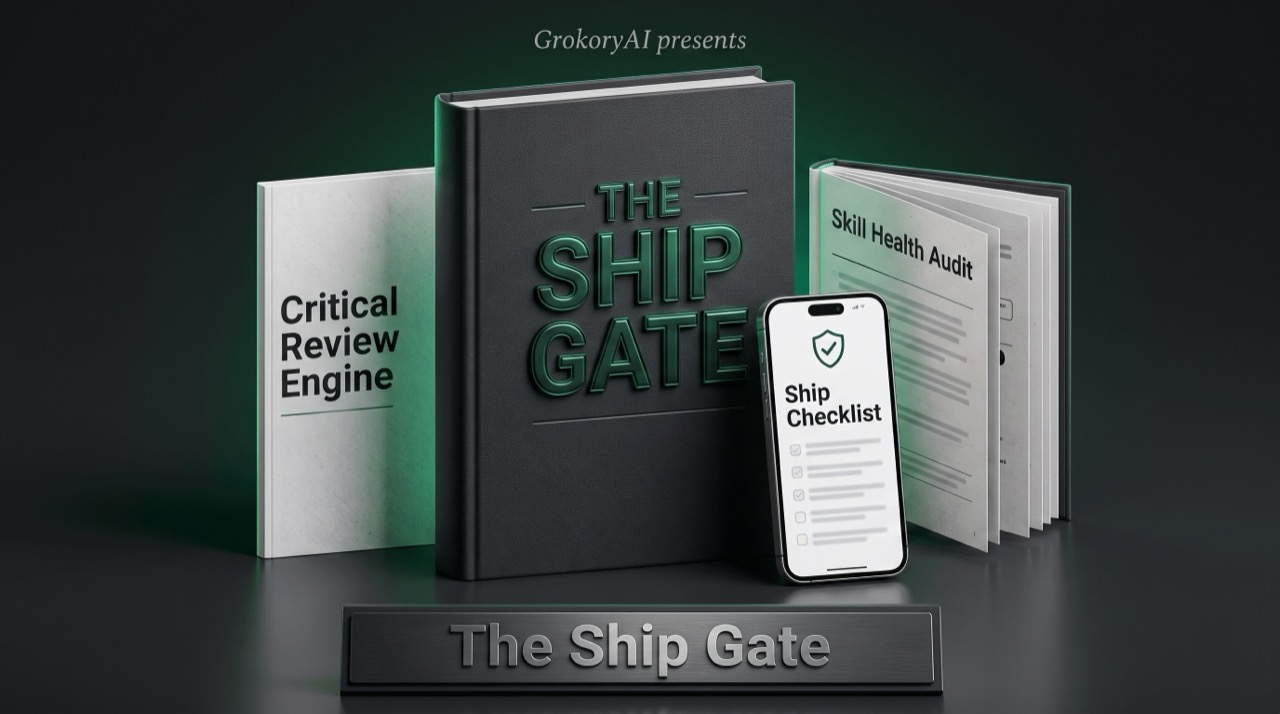
Seven skills and one Python tool.
Copy the skill files into your Claude Code commands directory. Keep the monitor tool somewhere stable and note its path.
- setup - run this first. Wires the review's strategy file, your command directories, and the monitor tool.
- critical-review - eight-dimension review of a doc, spec, plan, skill, or client-facing collateral. The centre of the pack.
- skill-builder - scaffold a new skill or multi-skill system with a real input and output contract.
- skill-audit - health-check your skill library: bad frontmatter, dead references, duplicates, orphans.
- memory-health-check - audit your agent's memory store for contradictions, staleness, and index drift.
- wrap-up - close a session into project memory so the next one starts warm.
- mcp-monitor - health-check your MCP servers and scan their logs for errors. Drives the bundled Python tool.
critical-review, and why it does not inflate.
- Scores and statuses cannot disagree. 5 is PASS, 3 to 4 is FLAG, 1 to 2 is BLOCK, deterministically. A "4/5 BLOCK" is a contradiction the skill will not let you write
- No score below 5 without a stated finding, and no finding without a consequence. "This could be clearer" is not a finding
- Applicability is declared up front. The pre-flight forces you to say which dimensions are N/A and why, so an internal SOP is not scored on SEO
- It verifies before it scores: read-only spot-checks on commands meant to run, and source-reading on plans that claim to modify existing code
The Python tool the monitor skill drives.
- Reads your config and log files, makes read-only health requests
- Never modifies your MCP setup
- Ships with example server entries, not a working registry, because a server list is inherently personal
A real review, on a real product, including what it caught.
The pack includes an actual critical-review run the author did on a product before shipping it. Nothing in it was invented for the sample, and the finding that was deliberately not fixed is left in.
Verbatim from the bundled report. Two dimensions marked N/A with a stated reason, not silently skipped.
A finding from that same report
The renderer silently substituted placeholder branding. If a buyer ran a build before completing setup, the renderer fell back to literal placeholder strings and produced a complete, successful-looking PDF containing them.
Consequence: the failure is invisible at the moment it happens. The build prints success, the file looks right at a glance, and the placeholder text surfaces later, plausibly after the buyer has sent the PDF to a customer.
That is the shape every finding takes: what it is, then what it costs. Not a list of preferences.
Operators whose skill library has started to sprawl.
Anyone shipping client-facing work
The gap between "it's done" and "it's live" is where the expensive mistakes live. This is a structured pass over that gap.
Builders with 20+ skills
Dead references, duplicate commands, and stale frontmatter accumulate silently. The audit skills find them before they bite.
Anyone running a memory store
Memory rots in a specific way: entries contradict, get superseded, and the index drifts from the files. There is a skill for exactly that.
What it needs, and what it does not do.
Read this bit properly. It is cheaper for both of us than a refund.
Requirements
- Claude Code, with custom command support
- Five of the seven skills need nothing else. They read and write markdown in your own repo
- mcp-monitor needs Python 3.12+ with httpx and rich
- No paid API, no third-party SaaS, no account
Limitations, stated plainly
- The strategy dimension marks itself N/A until you point it at a real strategy file. That is intended. A strategy dimension scored without one is inventing rules
- The monitor ships example server entries, so a first run reports them unreachable until you replace them with yours
- The regulatory dimension names Australian statutes because that is where it was written. The categories are near-universal, the act names are not, and the skill lists the US, UK, EU, and Canada equivalents to substitute
- critical-review checks whether it is running on an Opus-class model and tells you if it is not. You can proceed anyway, you will just be told what you are getting
- Default log paths for the monitor are macOS, called out in-file for Linux
- Updates are at the author's discretion. There is no guaranteed release cadence
Questions worth asking first.
Why does the strategy dimension start as N/A?
Because out of the box there is no strategy file to check against, and a dimension scored without one is inventing rules. An invented rule is worse than an unscored dimension, so it marks itself N/A and says so. Point it at a real strategy document when you have one and the dimension activates.
Is the review just an LLM giving opinions?
It is an LLM, so judgment is involved. What the skill adds is structure that constrains it: scores and statuses must agree deterministically, no score below 5 is allowed without a stated finding, and no finding is allowed without a stated consequence. It also verifies before scoring, with read-only spot-checks on commands and source-reading on plans that claim to modify existing code.
Does it work outside Australia?
Yes, with one caveat you should read first. The regulatory dimension uses Australian statutes as its worked examples because that is where it was written. The categories it checks are near-universal, and the skill lists the US, UK, EU, and Canada equivalents inline so you can substitute them.
What is the model floor about?
critical-review opens by checking whether it is running on an Opus-class model and says so if it is not. Judgment quality is the entire product of a review skill, so a review that quietly runs below the bar gives you false comfort. It is a disclosure, not a paywall. You can proceed either way.
Will the MCP monitor change my setup?
No. It reads config and log files and makes read-only health requests. It never modifies your MCP configuration. It ships with example entries rather than a working registry, so replace those with your own before the results mean anything.
How is this priced?
One-time, no subscription, no upsell sequence. It is the cheapest of the three packs because it is the smallest: seven skills and one tool. The honest anchor is one caught mistake in something you were about to send a client.
The gate between "it's done" and "it's live".
Instant download. One-time purchase, USD. No subscription, no upsell page, no drip sequence.
Get the pack - US$19